Biblical Engagement:
Derek's Bible Study Tips
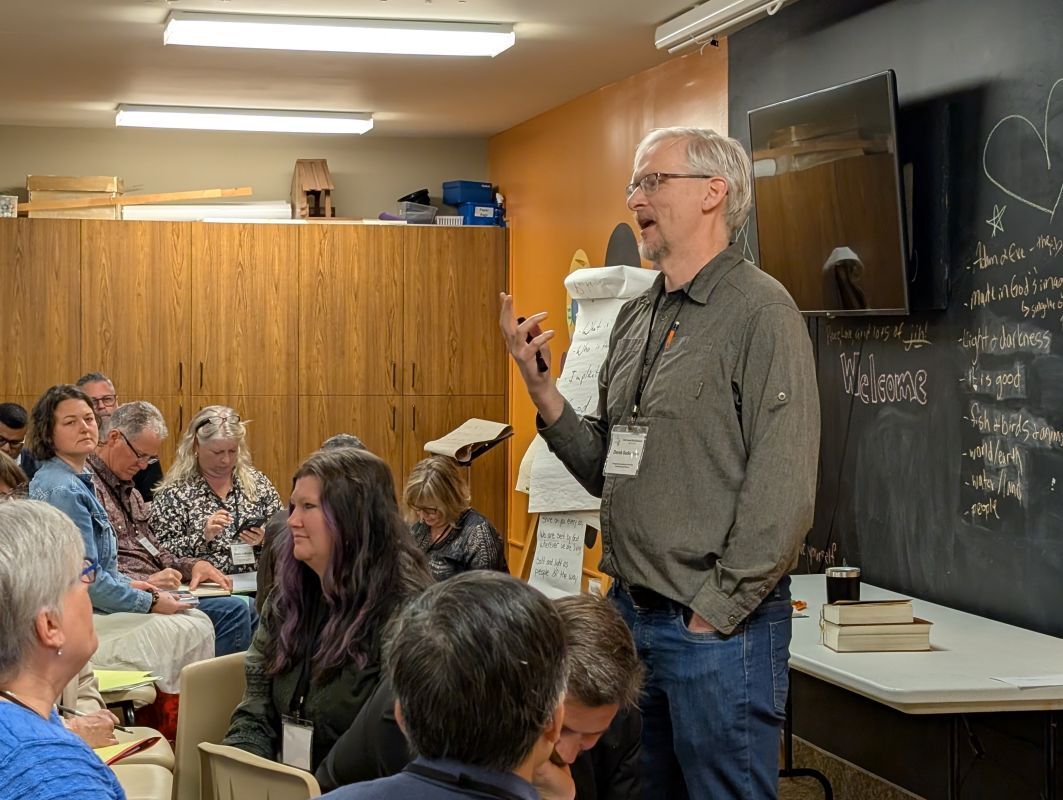
Derek Suderman at the 2026 MCEC Annual Church Gathering, presenting a workshop entitled Gather Around Scripture: An Invitation to Dynamic Bible Study.
Derek Suderman, Associate Professor at Conrad Grebel University College, is the lead facilitator in the “Catching the Spark” initiative that explores engaging, interactive ways of reading the Bible together.
This summer I attended a conference of Anabaptist and Mennonite leaders from all over Central America and the Caribbean with the theme: “The Relevance of Anabaptism for Today.” Rather than talking about specific historical details from the 16th century, speaker after speaker focused on what ‘discipleship’ looked like in the context of European “Christendom” back then, and then what they could learn and apply towards a contextualized discipleship in contemporary Latin America. The follow-up question was just as crucial - What is the “kingdom of God” calling us to in our time and place?
“If we are dedicated to discipleship, we need to know who we are following.”
And there was absolutely no doubt – in their view a (the?) central, essential element of this effort lay in consistently engaging the Bible together. As one speaker said – “If we are dedicated to discipleship, we need to know who we are following.” And how else do we deepen this understanding than by studying the Bible together? I left both inspired and challenged.
Frameworks for Bible Study – Leading towards Transformation
But we all know not all Bible study is created equal… In fact, I routinely have folks, including some church leaders, ask me to not use the term ‘Bible study’ because they don’t want to discourage or turn people off from coming. How have we gotten here, to where ‘Bible study’ for many has become something of a poison pill in some of our communities? Before giving some concrete suggestions, it’s worth backing up a moment to ponder a larger framework for considering Bible study.
We all know not all Bible study is created equal.
What do we think Bible study is for? What are we trying to do in this practice? I often encounter folks who think of Bible study largely as ‘information’ (often spurred by concern with declining ‘biblical literacy’). In this mode, Bible study often looks like having a knowledgeable person standing at the front, with rows of chairs facing them – the others’ role is to listen and ask questions, and the leader’s role is to answer all of them. A second very common mode casts Bible study as ‘participation.’ In this case, chairs are placed in a circle, and ‘success’ is measured by how many people speak up --- regardless of the content (or frankly, relevance or insight) of such comments. Unfortunately, this can easily devolve into the most opinionated folks in the room waxing on, while others squirm in their chairs or roll their eyes. All too often a few people share their pre-conceived opinions (tangentially related to the passage purportedly under consideration), and then participants walk out largely the same as they walked in…
The ultimate goal of Bible study should actually be transformation.
The first mode tends to attract people who like the sound of their own voice, or the same recognized person or two people always need to lead – if they don’t, nothing happens. Or alternatively, you may have a horrible time recruiting facilitators, since fabulous potential leaders rule themselves out, thinking – “what if someone asks a question that I can’t answer?” The second mode can lead to a wonderful exchange. It can also devolve into a pooling of ignorance, or the repeated riding of various ‘hobby horses’ that have little to do with the passage supposedly under discussion.
Or we may say things like – “don’t worry, x resource (curriculum, study guide, video series) does all the work, and you just need to facilitate the conversation.” And so the leader predictably does no preparation (did you know that the average Sunday School teacher does less than 6 minutes of preparation?). And then we wonder why people aren’t engaged.
I would suggest that we focus on biblical ENGAGEMENT rather than biblical literacy
Is there a different way? How can we avoid driving into one ditch or the other? I would suggest that, instead of thinking about Bible study as either ‘information-transmission’ on one hand or simply ‘participation’ on the other, the ultimate goal of Bible study should actually be transformation. Bible study is a key venue for training and forming disciples for the kingdom. This is a challenging and complex task, which means our engagement with the Bible and each other should also dare to be challenging and complex.
Trying to follow Jesus without studying the Bible is kind of like trying to play hockey without a puck, or soccer without a ball.
At its most basic, I would suggest that we focus on biblical ENGAGEMENT rather than biblical literacy. If we habitually and repeatedly engage with Scripture in a dynamic, engaging way (‘participation’ is key!), people will inevitably become more knowledgeable about it (ie. ‘biblical literacy’ will improve). In other words, biblical engagement will lead to enhanced biblical literacy, while the inverse is often not the case. Done well, people will walk out of a Bible study with more than they came in – the experience will be life-giving and prompt movement on the road to transformation. For a tradition focused on ‘discipleship,’ it seems odd how often we neglect the basic commitment to study Scripture, a practice that so clearly grounded Jesus’ life and ministry. Trying to follow Jesus without studying the Bible is kind of like trying to play hockey without a puck, or soccer without a ball…
Some Random Thoughts and Tips (not in priority order!)
In light of this, what are some concrete ‘tips for Bible study’ (my actual assignment for this article)? Given what I outlined above, you will see that several of these tips have to do with the facilitator – we have LOTS of ‘written resources’ for Bible study, but in my view we don’t have nearly enough ‘human resources’ (people!) who are willing and able to effectively facilitate a Bible study towards transformation.
Before a Study
- Be interested in what you are leading, and prepare – choose a topic/ passage and then get to work. Spend the time necessary and find resources (both written and human) that spark your own interest in the material and give you things to contribute. Go to a conference, talk to someone. Even better, attend a Bible study yourself, and then consider developing your own on a similar or related passage/ topic. After all, if the leader signals that they are bored or disengaged, why would anyone else want to join in?
- Keep a specific passage central to your study – this levels the playing field, so that relative ‘novices’ and people with lots of knowledge can engage it together. And often someone with no knowledge of the Bible will ask the key question or make a crucial observation that more ‘seasoned’ readers miss or skip over.
- Be aware (beware!) of constantly choosing ‘themes’ - this might sound odd, but often ‘Bible studies’ provide an excuse or platform to do something else, so that the Bible functions as a secondary resource for the real ‘main event.’ We decide we want to convince our congregation to get on board with ‘creation care,’ or Indigenous issues, or to have a particular stance on a certain ethical issue, or whatever else. And then the biblical text becomes a thematic foil (often a textual soapbox or pretext) for the leader to say what we would have said without it… What would happen if we reversed this trend? What if our congregations, peace and ‘creation care’ groups, even building committees and church councils would be so immersed in biblical engagement that this would ground their perspective and ‘spin out’ ideas for how to live out our faith in our contemporary context?
- Thoughtfully prepare questions (and a sequence of questions), as much as or more than ‘content’ or ‘answers’ – the downfall of initial preparation can be that the leader is often so eager to share what they have learned that they end up ‘talking at’ the group instead of leading it…
During a Study
- Get into the Bible itself within 5 minutes. The way you begin a study is CRUCIAL. If you spend the first 20 minutes ‘giving context’ (ie: lecturing people what you think they should see), you have just set the tone for your time together. Your voice is what counts, and they are there to listen to you. Don’t be surprised if you ask a question and you hear nothing but crickets.
- Be clear about your role as a facilitator. This is key. For myself, I like to use the metaphor of going on a hike. Just as hiking with an enthusiastic and knowledgeable guide can enhance one’s experience, the purpose of the hike is not ‘information’ but building curiosity and wonder. A key metric is whether the group is interested in tackling another, perhaps more challenging, ‘trail’ sometime soon.
- Become comfortable with silence. Once you have developed good questions, ask it and then sit back and smile… It will often take an initial session for participants to evaluate if you are serious about your question, or if you are simply wanting a specific answer so that you can talk. Waiting, sitting in silence, or reframing the question (but NOT answering it yourself) signals that you actually want to hear from them
- Foster a sense of discovery. Even if you know what you would like people to notice or consider, leading the group to discover it themselves is always more effective (and memorable!) than saying it yourself. Lead them to water, don’t dump a bucket on their head!
- Redirect (or sensitively shut down) tangential or extended ‘hobby horse’ comments – we have all been in the situation where you know exactly what a specific person will say, regardless of topic or passage, because they have said it a million times before… My own strategy developed over the years has been to respond with some version of – “That’s really interesting. What in the passage gave you this idea…?!?” This both leads people to refocus on the passage under discussion – and sometimes makes the initial commenter *gulp* and squirm a bit, since what they said often had nothing to do with the passage or topic at hand…
After a Study
- Evaluate it. How did it go? What questions really engaged people? Where did it fall flat? How could this be improved next time?
- Coach and mentor. Have an experienced facilitator in your congregation or cluster walk alongside people as they ‘try their wings’ in leadership in this area.
- Plan for another study. People are often a bit intimidated after a long period where there has been no Bible study in their setting, and ask me, “where should we start?” There are many options – start with a Gospel, or a series of parables, or even Genesis 1, “the beginning.” In my view, the more important issue is not where we ‘start’ but rather the conviction and commitment that we don’t STOP…!
Catching the Spark!
Looking for a fresh way to engage Scripture or know someone who would enjoy exploring the Bible and Bible study? Join our “Catching the Spark” Bible study series.
Recently, Erb Street Mennonite church hosted Ruth: An Immigrant Story, sparking meaningful conversation and new insights. 
Visit our website to discover other studies offered this winter. Looking ahead, we hope to gather participants from across Ontario for a retreat, equipping and encouraging people to facilitate Bible study in their own congregations and communities.